How to Price a Property When Demand Keeps Changing
Seasonal and event-driven properties don't have steady demand. They lurch from empty to fully booked, and flat pricing punishes them at both ends of the swing.
5 min read • 23 Aug 2026

How to Get More Direct Bookings and Rely Less on OTAs
6 min read • 23 Aug 2026Volatile demand punishes flat pricing
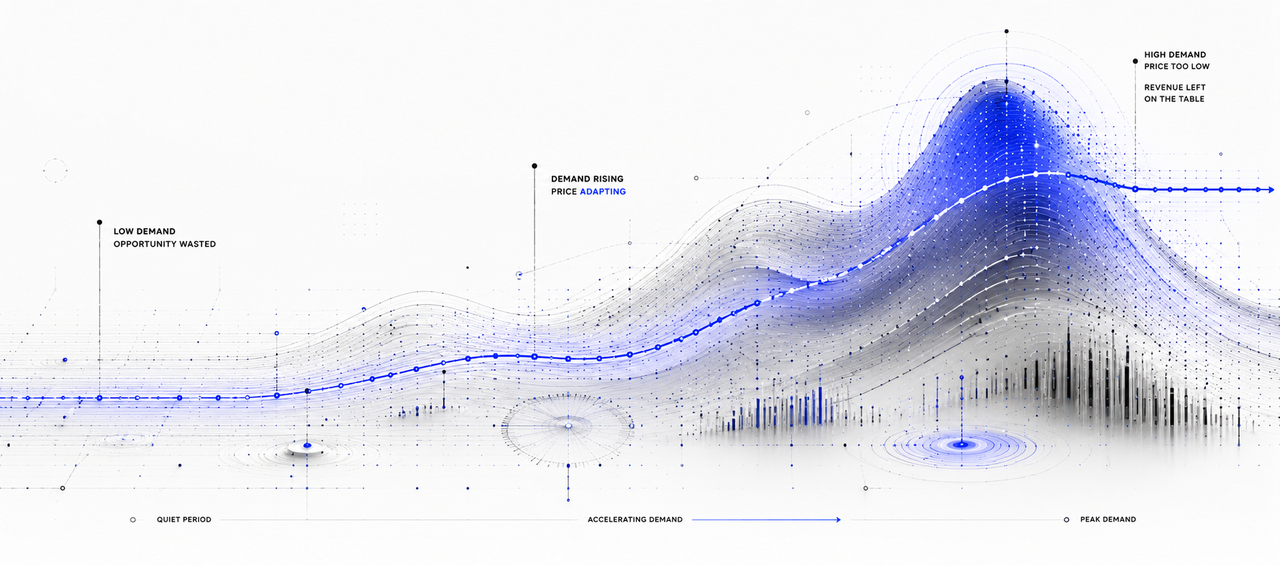
A city hotel has fairly predictable demand. A farmhouse, a hill-station homestay, a wedding venue does not. Its demand lurches: dead for weeks, then slammed for a festival, a long weekend, a wedding season. That volatility is exactly what makes pricing hard, and exactly what a flat rate handles worst.
Steady-demand pricing advice doesn't fit a property whose demand looks like a heartbeat monitor. The swings need a different approach.
When demand is stable, a flat rate is roughly right most of the time. When demand swings hard, a flat rate is wrong almost all of the time, in both directions. During the dead stretch it's too high, so the property sits empty when a lower price would have filled a few rooms. During the spike it's too low, so the property sells out early and leaves real money on the table it could have charged.
The bigger the swings, the more a single price costs you. And the properties with the wildest swings are often the independent ones least equipped to reprice constantly.
The manual version doesn't survive the swings
The obvious answer is to price the swings by hand: raise rates for the festival, drop them for the dead weeks. It works for the few dates you're paying attention to and fails everywhere else, because nobody can watch demand across a whole calendar and reprice daily, on top of actually running the property.
So in practice the manual approach captures the two or three obvious peaks and misses everything in between, which is where a surprising amount of the money is. The swings are too many and too frequent for a person to track well.
Manual pricing catches the festival and the long weekend. It misses the hundred smaller swings in between, which is where most of the money hides.
Pricing for swings without living in a calendar
The moat is a system that prices the swings for you within your rules. You set the strategy, how aggressive to be, floors below which you won't drop, ceilings, the events that matter, and the engine does the daily work: reading the signals that move demand and adjusting each night's price across the property, automatically, so you capture the spikes and fill the troughs without watching a calendar all day.
That's the honest version of revenue management for a small property. Not a full-time revenue manager you can't afford, and not a flat rate that bleeds money, but an automation that applies your judgment to every night so the swings become an advantage instead of a problem.
The test
Pull up your occupancy and your rate for the last big swing, a festival or a dead stretch. If your price barely moved while demand lurched, you paid for that flat rate twice, in the empty nights and the underpriced full ones. Letting a system price the swings within your rules is how a volatile calendar stops working against you.