Why a Tech Partner Who Stays Beats an Agency That Delivers and Leaves
The traditional agency ships the software and disappears. You're left with a product nobody on your side understands and a stranger to call when it breaks.
5 min read • 23 Aug 2026
The build-and-handoff model is built to fail you
There's a standard way software agencies work, and it quietly fails the client. They take a spec, go away, build for months, deliver, and move on to the next account. On paper you got what you asked for. In practice you're now holding software nobody on your side fully understands, with a slipping roadmap and a support relationship that's really a stranger you call when something's on fire.
That's the vendor model. It optimizes for the handoff. We think the handoff is exactly the wrong thing to optimize for.
The deliver-and-leave approach has a structural problem: the agency's incentive ends at delivery, and yours is just beginning. They're paid to ship a spec, not to make sure the thing works for your business over the years you'll actually use it.
So the software arrives matching the document and missing the point, because the document was written before anyone learned what the product needed to be. And the moment it's handed over, the people who understood it best walk out the door. You inherit a codebase and a set of decisions you weren't part of, and the knowledge that would let you evolve it left with the vendor.
A spec is a snapshot of what you knew at the start. Building to it and disappearing means shipping the least-informed version of the product.
Software isn't a project, it's a relationship
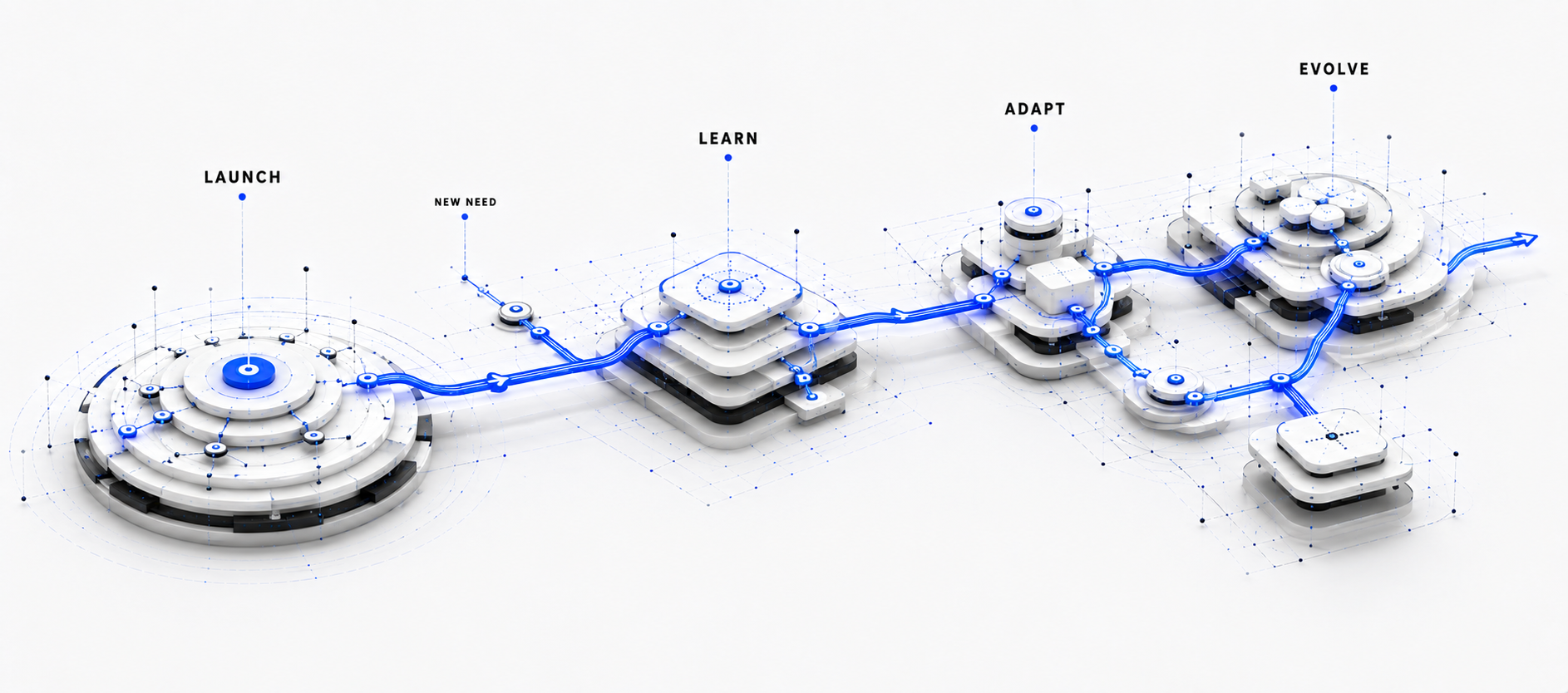
Here's the thing the vendor model gets wrong at the root: real software is never done. It ships, then it needs to change, because the market moved, the business learned something, a new need appeared. A product is a living thing, and living things need someone who stays.
Treating a build as a one-time project with an end date is a category error. The build is the beginning of the relationship, not the deliverable that ends it. What you actually need isn't a spec delivered. It's someone who understands your product and is still there when it has to grow.
What embedding actually changes
Embedding means the team building your product works like part of your team, not a supplier across a wall. They're in the roadmap, not just the spec. They stay after launch, so the knowledge doesn't walk out the door. And when the market shifts and the product has to change, the people who change it are the ones who built it and understand why it works the way it does.
That continuity is the whole difference. A vendor hands you software and a manual. A partner hands you software and stays to help you evolve it, which is the part that actually determines whether the product succeeds over time.
The test
Ask what happens to your software six months after it's delivered. If the answer is "we hope it keeps working and we file a ticket if it doesn't," you hired a vendor. If it's "the people who built it are still helping it grow," you have a partner. For anything your business genuinely runs on, the second is the only one worth having.